Czech Media Funding Reform Sparks Mass Protest and Tech Sector Concerns
A proposed shift to state-funded public broadcasting raises questions about media independence, startup visibility and investor confidence in Czechia.
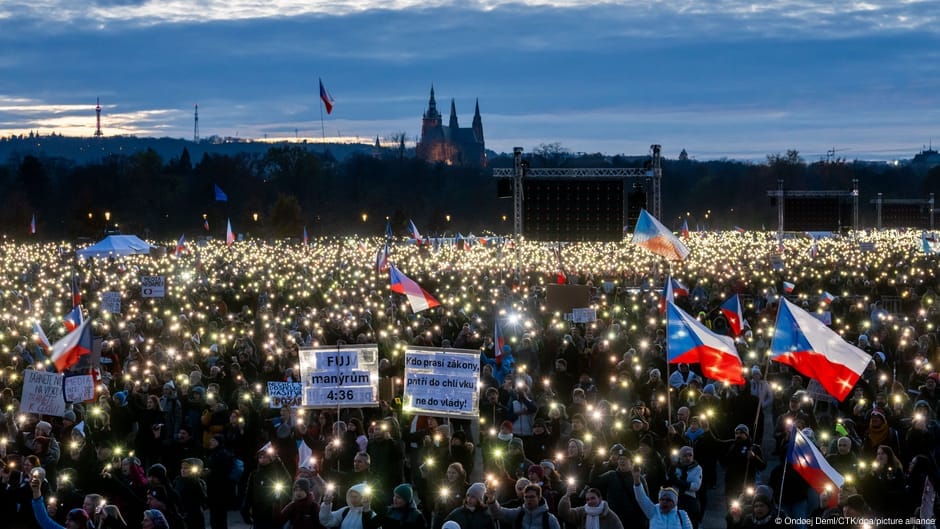
Hundreds of thousands of people demonstrated in Prague on Sunday, November 15, against the Czech government’s plan to overhaul the financing of public-service media, a dispute with potential implications for the country’s wider innovation and investment environment.
Organizers estimated that about 400,000 people attended the anti-government rally, according to Reuters, potentially making it one of Czechia’s largest protests since the Velvet Revolution. The demonstration centered on a proposal to abolish household license fees for public television and radio and replace them with direct funding from the state budget.
Critics argue that the change could threaten both the independence and the continued operation of the broadcasters. For technology startups, venture investors and other innovation-driven businesses, the controversy extends beyond the media sector. Independent public institutions, predictable policymaking and a diverse information market form part of the institutional framework investors assess when deciding where to deploy capital.
“An elected government has the right to govern the country. But it does not have the right to do whatever it wants and dismantle democratic institutions,” protest organizer Mikuláš Minář said, as quoted by Reuters.
Minář chairs Milion Chvilek, the initiative that organized the rally. Activists are demanding that the government either withdraw the bill or involve experts who can propose effective safeguards against political influence over public broadcasters.
Institutional Risk Enters the Investment Debate
The proposal does not directly regulate startups, venture funds or technology acquisitions. Its potential significance for the sector lies instead in how international investors may interpret changes to institutional independence. Venture capital depends heavily on confidence in transparent governance, stable rules and open access to reliable information, particularly in smaller markets seeking cross-border capital.
Public broadcasters also contribute to the visibility of science, technology, entrepreneurship and economic policy. A reduction in their resources could narrow the space available for reporting on emerging companies, research commercialization and regional innovation. That would not automatically reduce startup formation or funding, but it could weaken one channel through which founders reach customers, policymakers and prospective investors.
The handling of the legislation has intensified those concerns. Activists, civil-society organizations and the Czech opposition criticized the governing parties for introducing the bill for its first reading outside the planned parliamentary schedule on Friday, October 23, and arranging a vote for the same night. Such timing is highly unusual in Czech political practice.
The Prague demonstration, held at the Letná site, was named “Letná Against 4:36,” referring to the time scheduled for the vote. The episode has made legislative process and predictability central to the dispute—issues that also matter to founders and investors evaluating regulatory risk.
Funding Cut Could Reshape the Media Market
Czech public-service media are currently financed through monthly household fees totaling 205 Czech koruna, approximately €8.50. Prime Minister Andrej Babiš has said the reform would fulfill an election promise to reduce the financial burden on citizens.
However, moving the broadcasters onto direct budget financing would reduce the funds available to them by 15 percent. Czech Television’s nominal budget would return to its 2008 level, while Czech Radio’s would fall back to its 2005 level, even though operating costs in the sector have risen since then. Television and radio companies have described that outcome as unacceptable.
A contraction on that scale could affect more than newsroom staffing. Public broadcasters are buyers of production technology, digital infrastructure and services from outside vendors. Lower budgets may therefore reduce opportunities for media-technology startups, production companies and software suppliers serving the broadcasting market. At the same time, private media groups or technology platforms could gain audience share if public outlets reduce their output, potentially altering competitive dynamics and future consolidation opportunities.
The financial dispute has already disrupted operations. In early November, Czech public broadcasters staged a strike and restricted programming in protest over the proposed changes.
Political Context Raises Independence Questions
The governing coalition consists of right-wing and populist parties that formed a government led by billionaire Andrej Babiš. Coalition representatives, including the anti-immigration Freedom and Direct Democracy party, or SPD, have previously criticized media coverage of their activities, Reuters noted.
The opposition has compared the proposed reform with developments in Hungary under Prime Minister Viktor Orbán, where the authorities brought public-service media under government control. Czech campaigners argue that expert involvement and explicit institutional protections would be necessary to prevent budget decisions from becoming a source of political leverage.
For Czechia’s startup ecosystem, the immediate issue is not a forecast of funding volumes or M&A activity, for which no figures have been presented. The larger question is whether the controversy changes perceptions of the country’s institutional resilience. With the bill facing mass opposition, the government’s next steps may shape not only the future of Czech public broadcasting but also how founders and international capital providers assess the stability of the broader business environment.



