Georgia’s Renewed Protests Raise Risks for Startups and Venture Capital
Opposition leaders are mobilizing against Georgian Dream as a party-ban case deepens uncertainty around Georgia’s innovation economy.
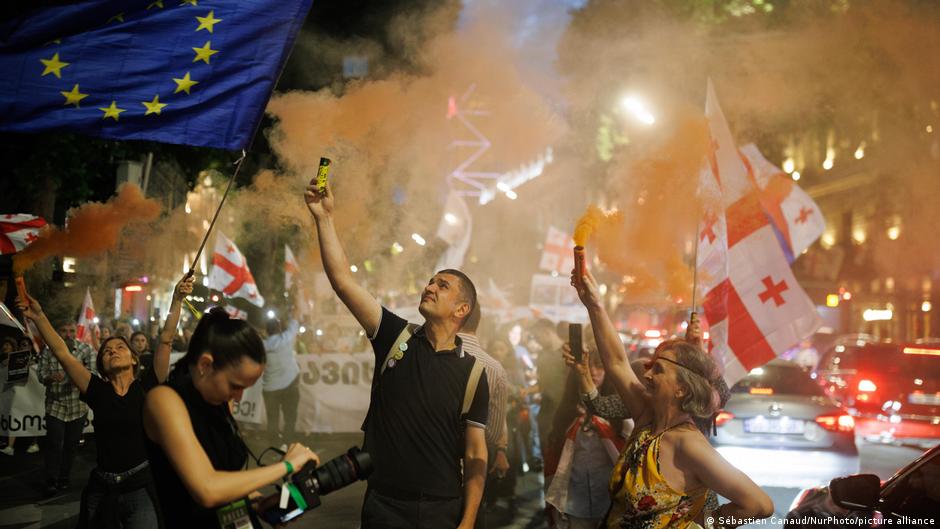
Thousands of protesters marched through Tbilisi on Sunday, October 25, as Georgia’s Constitutional Court considered a lawsuit seeking to ban opposition parties, opening a new phase of political uncertainty with potential consequences for the country’s technology startups, venture investors and innovation ecosystem.
The demonstration, organized by opposition representatives and civil society groups under the slogan “Georgia without Ivanishvili,” moved from Tbilisi State University toward Rustaveli Avenue. Participants carried Georgian, Ukrainian and European Union flags, while a large contingent of security personnel was also present, according to reports cited in the original account.
Nika Gvaramia, leader of the Coalition for Change, described the march as the beginning of a new wave of protests. Organizers are preparing a larger rally for November 28, the second anniversary of the start of mass demonstrations in Georgia.
“We are starting today, and we definitely need a culmination, whether it is on November 28 or in the following days. It is important that there are very many of us on the 28th, so that the wind cannot extinguish the fire,” Gvaramia said.
The planned mobilization adds to the uncertainty confronting founders and investors operating in Georgia. The country’s startup appeal has been linked to its international orientation and ambitions for closer integration with Europe. A prolonged political confrontation, restrictions on opposition activity or renewed clashes could complicate fundraising discussions, hiring decisions and cross-border expansion plans, even though the protest organizers did not announce measures directed specifically at technology companies or investors.
Political risk enters the venture equation
Venture capital depends heavily on predictable institutions, reliable access to international markets and confidence that companies can plan across several years. The Constitutional Court case and the prospect of sustained street protests introduce risks that investors may need to account for when evaluating Georgian startups, particularly those seeking foreign capital or building products for European customers.
Political volatility does not automatically halt startup activity, and the source article provides no evidence of canceled funding rounds, acquisitions or company relocations. However, uncertainty over Georgia’s democratic trajectory and its relationship with the EU may influence due diligence, valuations and the timing of investment decisions. International venture firms can delay commitments when legal and political conditions become harder to forecast, while local founders may face more questions about operational continuity and talent retention.
Gigi Tsereteli, leader of European Georgia, said the November 28 rally would be both large and important. He argued that the country had moved from being a leader on the path toward European integration to becoming an outsider, while political parties faced prohibition and political life was being restricted.
“What is happening in Georgia today in terms of the destruction of democracy and disruption is truly unimaginable,” Tsereteli said, also pointing to political prisoners as a major challenge.
For Georgia’s innovation community, the European integration dispute is especially relevant because startups often rely on mobility, international partnerships and access to customers beyond the domestic market. Any weakening of those connections could make it more difficult for early-stage companies to recruit globally, establish overseas entities or position themselves for acquisitions by international buyers.
A crisis rooted in the foreign-agent law
Georgia’s mass protests began in spring 2024 over the law on “foreign agents.” They intensified after the ruling Georgian Dream party won the parliamentary election and developed into a broader crisis in November 2024, when the authorities decided to postpone negotiations on joining the European Union until 2028.
Previous demonstrations included clashes with police, who dispersed protesters using tear gas and water cannons. That history raises the possibility that the renewed campaign could produce further disruption if tensions escalate around the Constitutional Court proceedings or the November 28 rally.
Civil society is an important component of many emerging technology ecosystems, supporting entrepreneurship programs, education, research and connections with international institutions. Measures affecting such organizations can therefore have indirect consequences for startup formation and the networks that connect founders with mentors, accelerators and capital.
The latest march does not by itself establish a change in Georgia’s investment environment. Its significance for venture capital will depend on the court case, the government’s response, the scale and duration of the protests, and whether political tensions affect economic policy or international ties. For founders and investors, November 28 is emerging as the next major point to watch in a confrontation that now extends beyond party politics into questions about Georgia’s long-term place in Europe.



