Khodorkovsky Urges Europe to Offer Russia’s Elite a Path Away From Putin
The opposition figure said an orderly political transition could reduce conflict risks and reshape the environment for investment and innovation.
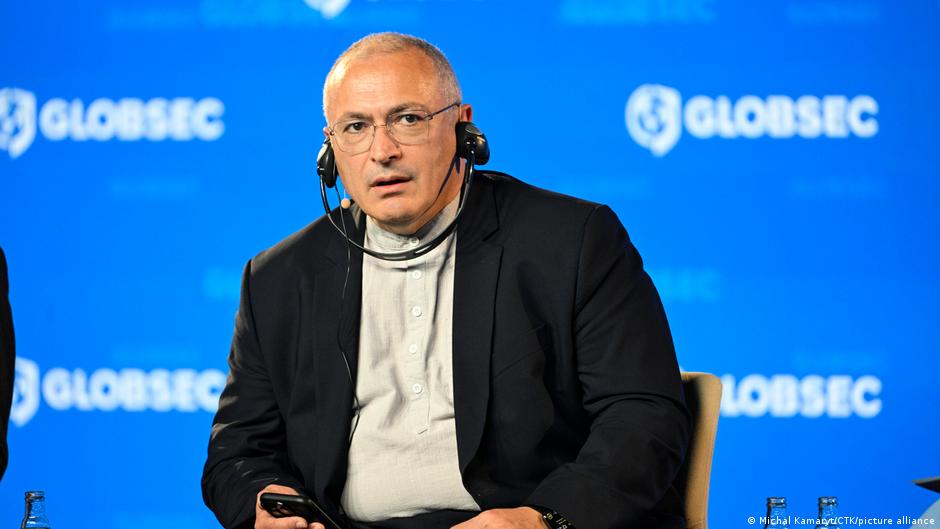
BRUSSELS — European governments should offer influential members of Russia’s elite a credible alternative to supporting President Vladimir Putin, according to public figure Mikhail Khodorkovsky, who argued that creating routes for individual defection could help divide the political and business establishment surrounding the Kremlin.
Speaking on Tuesday, Nov. 3, at a conference of the Russian Anti-War Committee in Brussels, Khodorkovsky said powerful Russians remain aligned with Putin partly because they are unconvinced that their position would improve without him. He was responding to a question about whether domestic actors could remove the Russian president.
Khodorkovsky pointed to the personal security system Putin has constructed and said any effort to split the elite must demonstrate that individuals have a viable way out. Such an exit could still involve losses for those concerned, he added. He called Europe’s failure to establish comparable options by the fifth year of the war a serious mistake.
“If we are talking about a split in the elites, then we need to show opportunities for a personal exit,” Khodorkovsky said.
He did not specify the conditions for such an arrangement at the conference. In earlier writing, however, he argued that a declaration of disagreement would be insufficient for people who had cooperated with the regime. He cited donations to Ukraine and testimony to investigators about crimes committed by the regime as examples of further action.
Political transition carries investment consequences
Although Khodorkovsky’s remarks focused on political strategy, the scenarios he outlined would have direct implications for Russia’s technology companies, founders and investors. The country’s innovation ecosystem operates within a political structure in which access to capital, international markets and potential acquirers is heavily affected by sanctions, war-related restrictions and relationships with the state.
A credible route for influential figures to break with the Kremlin could therefore extend beyond political insiders to business owners and capital holders whose decisions shape startup financing and corporate transactions. Khodorkovsky did not propose a venture-capital policy or discuss specific companies, funding rounds or acquisitions. His argument instead addressed the institutional conditions that determine whether economic actors see an alternative to continued alignment with the current system.
For venture investors, those conditions matter because political uncertainty can disrupt ownership rights, cross-border payments, talent mobility and exit markets. A disorderly transfer of power could deepen those risks, while a negotiated transition could influence whether technology assets remain investable and whether founders can reconnect with international networks. Khodorkovsky’s warning was that punitive policies applied too broadly could make a peaceful transition less likely.
Warning against sweeping lustration
In his opening address, Khodorkovsky said attempts to prosecute people connected with the war or restrict their rights could provoke armed resistance inside Russia. He said millions of Russians are linked to the war because they or their relatives fought, worked at military enterprises or supported the political order established by the authorities.
Some of those people are accustomed to handling weapons and could resist such measures, he said. The breadth of this group is significant for the wider economy: military production and state-directed industry have drawn workers, suppliers and technical expertise into the war effort, complicating any future effort to separate civilian innovation from state security structures.
“And we must understand that when we talk about lustration, reparations and trials of war criminals, we are talking about a new war,” he said.
Khodorkovsky contrasted efforts to force desired changes with national reconciliation and gradual democratization. In his assessment, an armed confrontation within Russia would produce another authoritarian system and postpone the prospect of democratic change for another political generation.
He issued a similar warning about the possible disintegration of the Russian Federation, saying such an outcome would be paid for in blood. He urged participants to discuss not only the result they wanted but also the means used to achieve it.
Institutional de-escalation as a risk framework
Khodorkovsky proposed focusing on what he called “institutional de-escalation”: reducing the threat of war by changing the structure of power in Russia. He said even a move from one-person rule to collective leadership could lower the probability of war. A parliamentary model and greater federalization would reduce that probability further, in his view.
For the startup and venture ecosystem, such institutional changes could ultimately be more consequential than any single financing initiative. Collective decision-making, parliamentary oversight and federalization could alter how state resources are allocated, how regional technology clusters operate and how investors assess political risk. Those possible effects remain implications of Khodorkovsky’s proposed framework rather than detailed measures announced at the event.
The two-day Russian Anti-War Committee conference is being held in Brussels on Nov. 3-4 and is devoted to scenarios for ending Russia’s war against Ukraine. Its program also includes discussions of sanctions, nuclear risks and the possibility of putting Putin on trial.



