Putin Signals Ukraine Talks but Rejects Front-Line Freeze, Clouding Tech Outlook
Moscow’s stance leaves the war’s trajectory unresolved, prolonging uncertainty for Ukrainian startups, venture investors and technology markets.
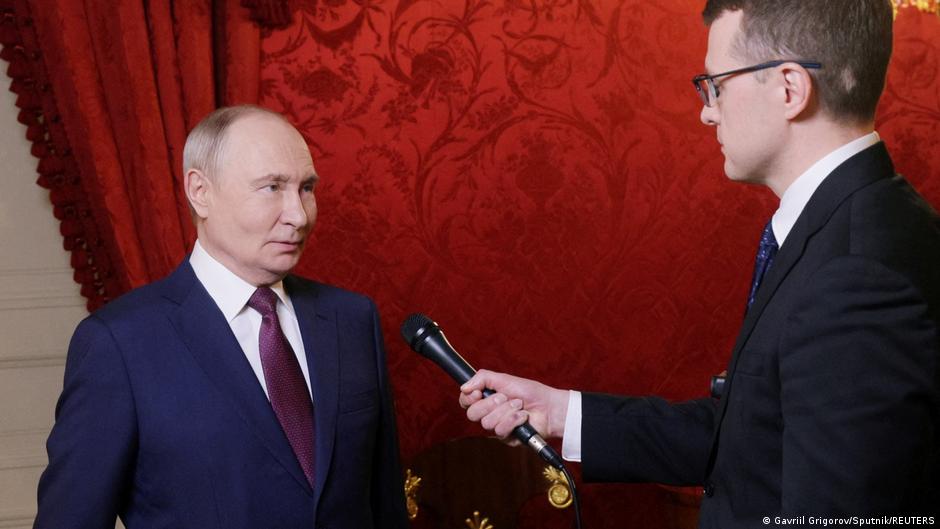
Russian President Vladimir Putin said Moscow was prepared to resume talks with Kyiv through US mediation, but rejected the prospect of freezing hostilities along the current front line, leaving little indication of an imminent reduction in the geopolitical risk confronting Ukraine’s startup and venture capital ecosystem.
In an interview with Pavel Zarubin, a journalist for Russia’s state-owned VGTRK media group, published on Thursday, October 22, Putin said he had agreed during a meeting with US special envoy Steven Witkoff to renew dialogue with Kyiv under Washington’s mediation.
“The purpose of these negotiations will be to discuss ensuring the security of Ukraine and Russia after peace agreements are reached, in their final form, rather than as a result of suspending hostilities for some short period,” Putin said. “We are ready to resume these contacts to achieve this goal.”
Moscow did not disclose what level of representation it would send to possible negotiations following Putin’s meeting with Witkoff. Ukrainian President Volodymyr Zelensky has said he is ready for a trilateral meeting with Putin and US President Donald Trump to discuss ending the war. The Kremlin has repeatedly rejected that format or attached conditions that Kyiv did not regard as a serious basis for talks, including a proposal that Zelensky travel to Moscow.
Previous meetings between a delegation selected by Putin and Ukrainian representatives produced no tangible progress toward ending the war. The diplomatic outlook was further complicated when, only hours after the Putin-Witkoff meeting, Russian presidential aide Yuri Ushakov said Moscow was “completely dissatisfied” with the proposals brought to Russia by Trump’s negotiators.
No agreement on a front-line freeze
Zarubin also asked Putin about Zelensky’s statement a day earlier that Ukraine was prepared to freeze hostilities along the current line of contact. Putin rejected that position, saying: “This is not their territory; this is the territory of historical Russia.”
Media reports previously said Trump had supported the idea of freezing fighting along the front line running through the Donbas in 2025, before meeting Putin in Anchorage. Such an outcome conflicts with the Russian leader’s publicly stated demand that Ukraine surrender the entire Donbas region to Russia without a fight.
The gap between a temporary ceasefire and Moscow’s insistence on a final settlement is significant for technology founders and investors assessing whether the operating environment could stabilize. A durable agreement could eventually reduce security uncertainty, while a short pause might offer less confidence for long-term capital commitments, acquisitions or cross-border expansion. Putin’s rejection of the current front line as a basis for a freeze, however, signals that the territorial dispute remains a central obstacle.
Wartime risk remains embedded in startup decisions
For Ukraine’s innovation economy, the absence of a credible path to reduced hostilities keeps geopolitical risk at the center of financing and M&A calculations. Startups, venture funds and potential strategic buyers must continue to evaluate decisions against the possibility of further attacks, infrastructure disruption and an uncertain timetable for any settlement. The latest statements establish no ceasefire and provide no agreed negotiating format or schedule.
Putin also claimed that Russia “does not want to fight” Ukraine and placed responsibility for the continuation of hostilities on Kyiv. “We are still ready to reach agreements and look for solutions to this difficult situation,” he said. “These are people very close to us. The latest genetic studies show that Russians and Ukrainians are one people.” Putin did not explain how genetics could affect national sovereignty.
Russia launched the war against Ukraine, and its forces have continued striking Ukrainian territory. The intensity of Russian attacks did not decline after Putin’s meeting with Witkoff, according to the source report, underscoring the disconnect between renewed talk of negotiations and conditions on the ground.
On the day Zarubin’s interview was published, Ukrainian authorities reported multiple Russian attacks on civilian targets. The reported sites included a clothing market in Lozova in the Kharkiv region, Kyiv’s historic center, and roads and bridges across several Ukrainian regions. Two people were killed and 34 were wounded in the Russian strike on Lozova.
Those attacks reinforce the immediate operational challenges facing companies whose employees, customers, logistics or infrastructure remain in Ukraine. They also limit the clarity that venture investors and prospective acquirers typically require when pricing risk or planning transactions. Although US-mediated contacts could create a channel for further diplomacy, the conflicting positions on territory, the Kremlin’s dissatisfaction with US proposals and the absence of results from earlier meetings leave the innovation ecosystem without a clear signal that wartime conditions are about to ease.



