Slovak Protests Raise Political Risk Questions for Startups and Investors
Mass demonstrations against Robert Fico’s government highlight governance concerns that could shape Slovakia’s technology investment climate.
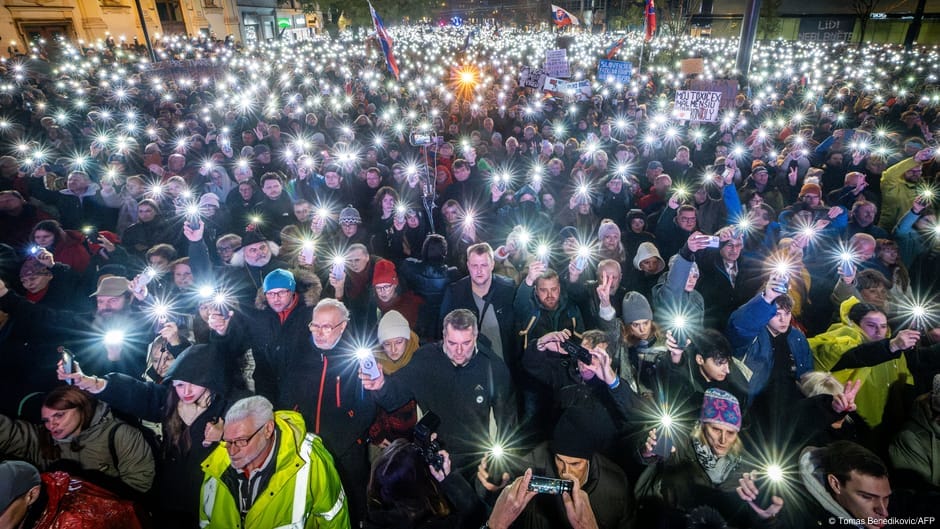
Thousands of people took to the streets across Slovakia on Monday, November 17, in demonstrations against Prime Minister Robert Fico’s government, its links with the Kremlin and its approach to media control, LGBT rights and the rule of law.
The protests coincided with the 37th anniversary of the beginning of the 1989 Velvet Revolution in Czechoslovakia. That historical backdrop gave the rallies added significance: demonstrators connected present-day concerns over democratic institutions with the movement that helped end communist rule more than three decades ago.
The largest gathering was held in Bratislava’s Slovak National Uprising Square. Progressive Slovakia, the country’s largest opposition party and the organizer of the event, estimated that approximately 25,000 people participated.
For Slovakia’s startup and venture capital ecosystem, the demonstrations bring attention to the political and institutional conditions surrounding investment. Technology founders and investors generally depend on predictable regulation, independent institutions and confidence in the rule of law when making long-term decisions. The protests do not in themselves indicate an immediate change to business policy, but they expose a broader dispute over the country’s direction that market participants may monitor closely.
Political uncertainty enters the investment calculus
Slovakia’s political tensions come as Fico’s three-party governing coalition faces a weakened position in parliament. The coalition recently lost its absolute majority after several lawmakers withdrew from it. Opposition parties have since called for an early parliamentary election, although they do not have enough votes to approve one.
That parliamentary arithmetic leaves the government in office while increasing uncertainty around its capacity to pursue legislation. For venture-backed companies, a prolonged political confrontation can complicate expectations about regulation, public-sector partnerships and future economic policy. Investors considering Slovak startups may also weigh whether institutional disputes could affect the country’s ability to attract and retain skilled workers or remain integrated with wider European innovation networks.
The demonstrations included direct criticism of the government’s relationship with Moscow. Some placards read “Russians, go home!” and “I don’t want a country I will have to flee.” Several protesters told AFP that they were unhappy with Slovak Foreign Minister Juraj Blanar’s recent visit to Moscow.
“We are tired of Fico!” the crowd chanted as demonstrators demanded the resignation of the prime minister’s three-party government.
Foreign-policy positioning can matter to technology companies beyond the political sphere. Cross-border venture investment depends heavily on perceptions of geopolitical alignment, regulatory consistency and access to international markets. Founders seeking capital from investors elsewhere in Europe may therefore face more questions about Slovakia’s policy trajectory if tensions between the government and its opponents continue.
Talent and institutional trust are central concerns
The language used by protesters also pointed to concerns about emigration. The placard warning of a country people might feel compelled to leave is particularly relevant to a startup economy, where competition for engineers, product specialists and experienced executives is intense. Slovakia’s ability to build innovative companies depends partly on whether skilled professionals believe they can pursue stable careers and businesses at home.
The rallies also focused on government policies affecting the media, alleged violations of LGBT rights and concerns about the rule of law. These issues can influence how international investors assess a market’s openness and institutional resilience. They may also affect recruitment at companies that need to attract diverse teams from across borders.
No specific startup, venture capital transaction or technology acquisition was cited in connection with the demonstrations. Nor did the protests establish that funding or mergers and acquisitions would decline. Their significance for the innovation economy lies instead in the questions they raise about political stability, institutional safeguards and Slovakia’s international orientation.
Domestic founders will be watching whether the governing coalition can operate effectively without an absolute parliamentary majority and whether the opposition can translate street mobilization into political change. With the opposition currently lacking the votes needed to force an early election, the immediate outcome remains constrained by the balance of power in parliament.
For investors, the central issue is likely to be whether the confrontation produces policy disruption or remains a contained political dispute. Slovakia’s demonstrations have made clear that a substantial segment of the public views the rule of law, media independence, minority rights and relations with the Kremlin as connected questions about the country’s future. Those same factors form part of the environment in which startups compete for capital, talent and international partners.



