Warsaw Independence March Highlights Political Risk for Poland’s Startups
The mass nationalist rally underscores political divisions that could influence investor perceptions of Poland’s technology ecosystem.
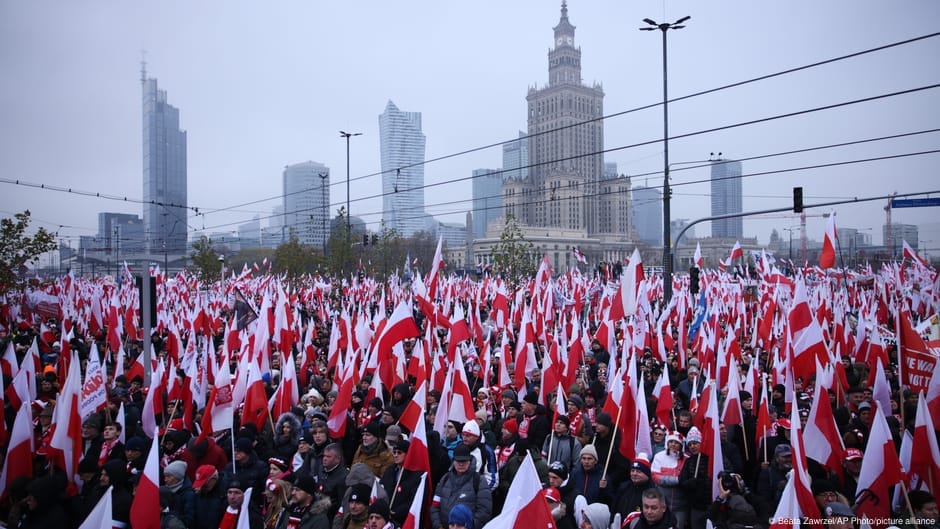
Polish President Karol Nawrocki joined a large Independence Day march in Warsaw organized by nationalist and far-right groups, placing the country’s political divisions in sharp focus for businesses and investors assessing Poland’s innovation economy. Warsaw authorities estimated that about 250,000 people participated in the demonstration on Wednesday, November 11, while organizers claimed that the crowd exceeded half a million.
The annual event commemorates Poland’s restoration of independence on November 11, 1918, after 123 years of foreign rule by Russia, Prussia and Austria. Far-right groups have organized similar demonstrations in the country every year since 2011.
This year’s march took place amid heightened security, only days after a shooting in central Krakow that killed six people. It also unfolded during a struggle between Prime Minister Donald Tusk’s government and Nawrocki’s presidential camp for control of the Constitutional Tribunal.
Political divisions enter the investor-risk equation
For venture capital firms, technology founders and potential acquirers, the immediate significance of the march lies less in the event itself than in the wider political environment it displayed. A public confrontation over a central judicial institution, combined with a mass demonstration featuring nationalist and anti-immigration messages, adds another variable to assessments of regulatory stability and Poland’s international business climate.
That matters particularly to startups, which often depend on cross-border capital, international hiring and access to customers across multiple markets. Investors evaluating young companies must account not only for product and execution risks, but also for the institutional conditions in which those businesses operate. Political polarization can therefore become part of due diligence around funding decisions, expansion plans and mergers and acquisitions, even when no immediate policy change has been announced.
The demonstration began with the Polish national anthem. Some participants carried torches whose thick smoke covered sections of the procession, according to AFP. Many attendees wore Poland’s red and white national colors and waved national flags.
Near the Palace of Culture and Science, tents and stands formed what journalists described as a so-called “city of independence.” Rosaries, prayer books, red-and-white wreaths, hot tea and sauerkraut were distributed there. The area also featured antisemitic and anti-Ukrainian books, along with objects bearing far-right extremist symbols.
Among the slogans displayed were “Make Europe white again,” “Poland is not for sale” and “Remigration, deportation.”
The first slogan echoed the structure of “Make America Great Again,” associated with supporters of US President Donald Trump. Although one accompanying Russian-language explanation rendered it as “Make Poland white again,” AFP reported the displayed English wording as “Make Europe white again.”
Talent and international growth remain key sensitivities
The nationalist themes visible at the march are relevant to an innovation ecosystem whose companies may seek employees, partners and financing beyond Poland. Anti-immigration rhetoric can create reputational concerns for founders competing internationally for skilled workers, while anti-Ukrainian material may be particularly sensitive in a regional business environment shaped by close economic and human ties across borders.
No direct changes to startup, investment or immigration policy were announced at the event. Nor did the march itself establish a measurable effect on venture funding or M&A activity. Its relevance for the technology sector is instead as a signal of the competing political forces surrounding the Polish state and of the social climate in which companies recruit, raise capital and negotiate transactions.
Nawrocki appeared at the march carrying a Polish flag in photographs distributed by AFP. The president called for a “strong and capable state” and criticized “elites acting against the will of the people.” His participation gave the annual demonstration a direct connection to the presidency at a time when his camp and Tusk’s government are contesting authority over the Constitutional Tribunal.
Tusk declined to take part in the demonstration. Instead, the prime minister appealed for national unity, saying: “On November 11, all hearts are white and red.”
The contrast between the president’s participation and the prime minister’s absence reflects the broader institutional divide confronting market participants. For startup executives, venture investors and corporate buyers, the practical questions will concern whether that divide affects legal predictability, Poland’s ability to attract international talent and the country’s position within European capital and technology networks.
Poland’s founders and investors now face the task of separating the symbolism of a major political event from its potential operational consequences. The march provided no new economic measures, but its scale, messaging and presidential presence ensure that political risk will remain part of conversations about the country’s innovation ecosystem.



