Zelensky Says Crimea Bridge Will Not Survive as Infrastructure Risks Mount
Further damage to the strategic link highlights wartime risks for infrastructure, logistics technology and investment across the region.
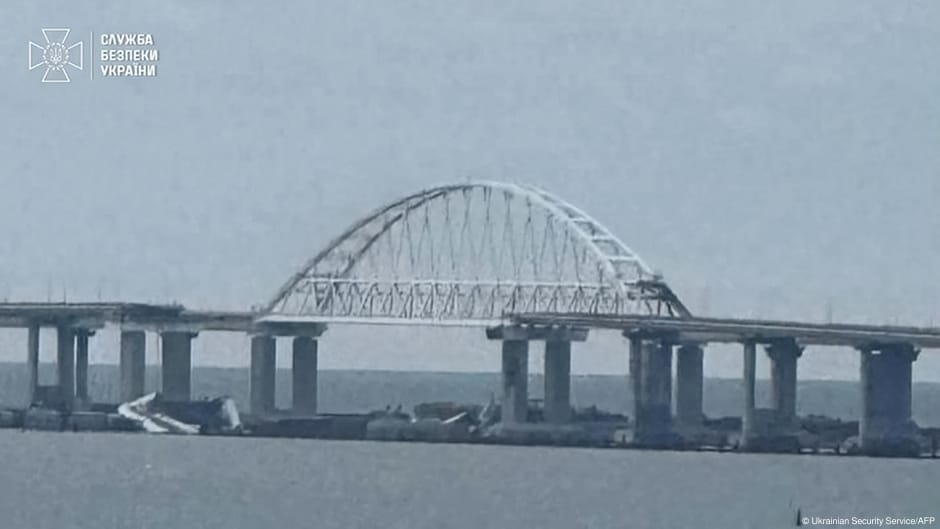
Ukrainian President Volodymyr Zelensky said the Crimean Bridge would not remain standing because Kyiv considers the Russian-built crossing a legitimate military target, a position that reinforces the severe infrastructure and investment risks facing technology companies operating in the wider region.
Speaking in an interview with NBC News on Friday evening, November 20, Zelensky addressed the future of the bridge across the Kerch Strait connecting Russia with Crimea, the Ukrainian peninsula annexed by Moscow. He said Ukraine was responding to Russian aggression and would not accept continued Russian control over occupied territory.
“Putin must understand that this bridge will not survive,” Zelensky said.
Zelensky argued that attacks against the structure are lawful because Russian forces have occupied Crimea since the spring of 2014. He described the peninsula as Ukraine’s territory and said Moscow had subsequently changed its constitution and domestic laws in an attempt to formalize its claims.
“This is our completely legitimate target because they occupied Crimea — our Crimea,” Zelensky said. “It was their first target in 2014. They occupied our territory. Then they built this bridge and declared that it was part of Russia.”
Those Russian actions have received neither international support nor international recognition, the Ukrainian president said.
Strategic infrastructure damage raises technology-sector risks
For venture investors and startup founders, the renewed focus on the Crimean Bridge illustrates how strategic infrastructure can become both a military target and a source of prolonged commercial uncertainty. Damage to road and rail links can disrupt logistics, complicate supply chains and increase the operating risks surrounding infrastructure-dependent businesses.
The situation is particularly relevant to companies working in logistics software, mobility, construction technology, engineering, satellite services and dual-use systems. It also underscores the difficult environment for mergers, acquisitions and venture financing when physical assets may require years of reconstruction and restoration schedules remain uncertain.
Zelensky indicated that strikes on the bridge could continue. He said Russia must experience the effects of war and recognize that it cannot retain control over the Ukrainian peninsula. He added that Russian forces had attacked several Ukrainian sites, requiring a response from Kyiv.
“They attacked several of our facilities, and, of course, we had to respond. And, of course, we responded with a strike on the Crimean Bridge,” he said. “In any case, whether diplomatically or militarily, we will not accept that territories are occupied by Putin and the Russians.”
Zelensky also said Russia continues to use the bridge to transfer as many weapons as possible to Crimea. According to daily reports from Ukraine’s armed forces, missile and drone launches frequently originate from the annexed peninsula.
Repair uncertainty complicates capital planning
Occupation authorities in Crimea reported a strike on the bridge on the morning of November 16 and restricted vehicle traffic. A day later, reports said one of the bridge’s arches and part of the roadway had collapsed into the sea following a repeated strike. The railway section was targeted overnight on November 19 and is now heavily damaged.
Russian Deputy Prime Minister Marat Khusnullin said on November 20 that Ukrainian strikes had damaged the main beam of an arched span as well as the arch itself. He told Russian journalists that the possible restoration timetable remained unknown and could be established only after engineers produced project solutions.
Russian authorities had announced the resumption of train traffic across the bridge a day earlier. Khusnullin said officials expected to assess the overall repair schedule within a week. Some individual elements might be restored within one or two months, he said, while the remainder would depend on further examination during a period of storms.
The gap between short-term operational measures and full structural restoration is significant for investors assessing companies exposed to regional transport networks. Uncertain repair costs and timelines can affect procurement, insurance, contracting and the availability of growth capital, while also creating demand for monitoring, inspection and resilient-infrastructure technologies.
Andriy Koretsky, an associate professor in the bridges, tunnels and hydraulic structures department at Kyiv’s National Transport University, estimated that restoring the Crimean Bridge could take between 18 months and three years. Producing the arch alone would take about a year, he said, after which it would still need to be assembled at a site, transported and installed.
Koretsky added that he did not believe Russian crews would be allowed to install another such arch near Ukraine’s border without disruption. His assessment points to a central problem for infrastructure financing in an active conflict: engineering feasibility does not guarantee that construction can proceed securely.
For the regional innovation ecosystem, the bridge’s condition highlights both risk and potential demand. Startups may find opportunities in infrastructure inspection, autonomous systems, supply-chain visibility and reconstruction technology, but fundraising and acquisition activity will remain shaped by security conditions, sanctions exposure and the durability of critical transport assets.



