Bosnia Vote Extends Dodik Allies’ Grip, Adding Policy Risk for Startups
Preliminary results point to continuity in Bosnia and Herzegovina’s complex power structure as ruling-party candidates prevail.
Preliminary election results in Bosnia and Herzegovina point to another term of political continuity for ruling-party candidates and allies of Milorad Dodik, a development likely to reinforce the policy uncertainty facing entrepreneurs, investors and technology companies operating in the country’s fragmented institutional environment.
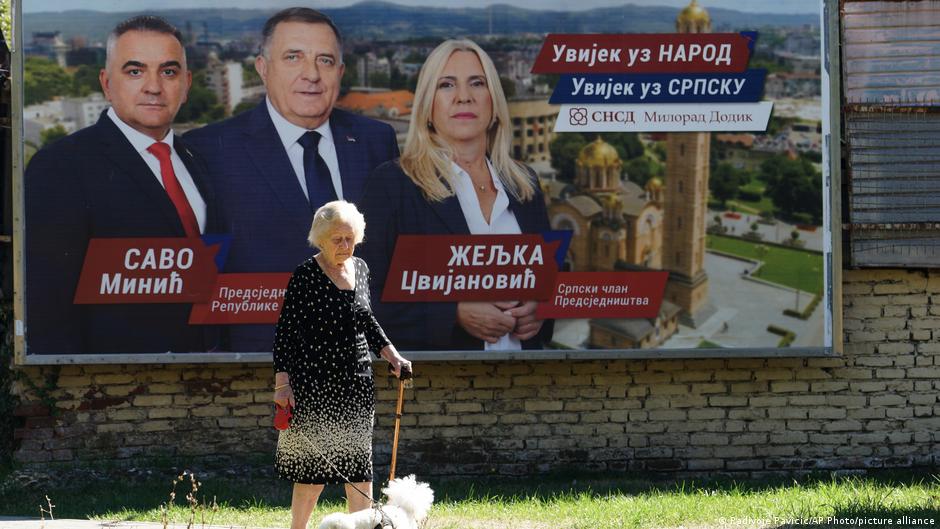
Savo Minic, the prime minister of Republika Srpska, won the election for president of the Serb-majority region, according to preliminary results. Minic was backed by Dodik, the former president of Republika Srpska who is known for his closeness to Russia. A Dodik associate, Zeljka Cvijanovic, also secured support to continue representing Serbs in the state-level presidency.
The vote covered members of Bosnia and Herzegovina’s presidency, the central parliament, two regional parliaments and the president of Republika Srpska. It produced few surprises. Preliminary results published by the Central Election Commission on Sunday evening, October 4, showed candidates from governing parties ahead across the main contests.
For founders and venture investors, the outcome matters less as a single electoral event than as a signal of continued institutional complexity. Bosnia and Herzegovina’s governance system divides authority across the state and regional levels, with competing political mandates often shaping regulation, public procurement, infrastructure priorities and relations with international partners. That structure can affect the environment for startups seeking predictable rules, access to public programs, cross-border partnerships or potential acquisition pathways.
Continuity Across Bosnia’s Power-Sharing System
After 95% of ballots had been counted, Denis Becirovic remained the leading candidate to represent Bosnian Muslims in the country’s presidency. Becirovic, who previously served as chairman of the presidency, had received about 38% of the vote.
Croats are preliminarily set to be represented in the presidency by Darijana Filipovic, who received about 48% of the vote. Serb voters favored Zeljka Cvijanovic, who received about 55% and had also previously served in the presidency.
Bosnia and Herzegovina has a unique presidential system in which the role of head of state is carried out simultaneously by representatives of Croats, Bosnian Muslims and Serbs, who occupy three seats in the presidency. The system was created under the 1995 Dayton Accords, which were concluded to resolve disputes among Bosnian Muslims, Orthodox Serbs and Catholic Croats and brought an end to the civil war. Many analysts regard the resulting system as inefficient.
For business, the election result points to continuity rather than a reset: the same complex political architecture remains central to decision-making.
The main uncertainty in the vote was the election for president of Republika Srpska, an entity within Bosnia and Herzegovina populated mainly by Serbs. The contest there was between opposition candidate Branko Blanusa and Prime Minister Savo Minic.
Minic preliminarily won the race. In most electoral districts in Republika Srpska, he was ahead of Blanusa. The opposition candidate was able to win some districts, but Central Election Commission data indicated that this did not change the overall result.
Implications for Startups, Capital and M&A
Minic, like Cvijanovic, ran for the Alliance of Independent Social Democrats, or SNSD, the party founded by Milorad Dodik, who was previously president of Republika Srpska. In 2025, Dodik was forcibly removed from office for failing to comply with decisions of Bosnia and Herzegovina’s Constitutional Court and with international agreements.
According to the Central Election Commission, SNSD is also winning the election for the parliament of Republika Srpska, known as the National Assembly. A majority of Bosnian Serbs also voted for the same party in elections to the lower house of the national parliament, the House of Representatives of the Parliamentary Assembly.
Dodik has already congratulated both Minic and Cvijanovic on their victories. Under a court decision, Dodik himself is banned from political activity for six years. He has refused to recognize the court ruling and traveled to Moscow seeking support. Dodik and Minic met Vladimir Putin at the Kremlin on September 29.
For Bosnia and Herzegovina’s innovation economy, the results underline the persistence of a political order in which regional authority, ethnic power-sharing and international alignments all shape the investment climate. Technology startups generally rely on fast administrative processes, credible legal enforcement and stable access to foreign customers and capital. A governance system widely seen as inefficient can complicate those needs, especially for companies seeking to scale beyond local markets.
Venture capital activity is especially sensitive to jurisdictional risk. Investors evaluating early-stage companies in smaller European markets often look not only at product and traction, but also at exit routes, regulatory reliability and whether founders can operate across borders without political friction. Continued dominance by existing ruling parties may offer predictability in personnel, but it does not by itself resolve the institutional frictions embedded in Bosnia and Herzegovina’s postwar constitutional framework.
The election also matters for mergers and acquisitions. Strategic buyers and private investors typically assess whether companies can complete due diligence, transfer assets, receive approvals and maintain contracts after a transaction. In Bosnia and Herzegovina, where state-level and entity-level authorities can both influence business conditions, political continuity may keep existing networks intact while leaving unresolved questions about reform and administrative efficiency.
There were no immediate signs from the preliminary results of a shift toward a different policy direction. Instead, the vote reinforced the position of SNSD and Dodik-aligned figures in Republika Srpska and at the state presidency level. For the country’s startups, accelerators and foreign backers, that means the next investment cycle is likely to unfold under familiar constraints: a divided political structure, contested authority and a need to navigate regional as well as national institutions.
The final significance of the election for the tech sector will depend on how the winning officials use their mandates. But based on the preliminary results, Bosnia and Herzegovina’s founders should expect continuity in the political environment that shapes funding access, public-sector partnerships and the confidence of outside investors.