Ukraine Says 28 Killed in Russian Barrage as War Risk Clouds Startups
The missile and drone assault across 13 regions underscores the persistent security costs facing Ukraine’s technology sector and investors.
Ukraine said 28 people were killed after a large-scale Russian attack involving missiles and drones, a strike that underscored the continuing human toll of the war and the risk environment confronting the country’s technology companies, startup founders and international investors.
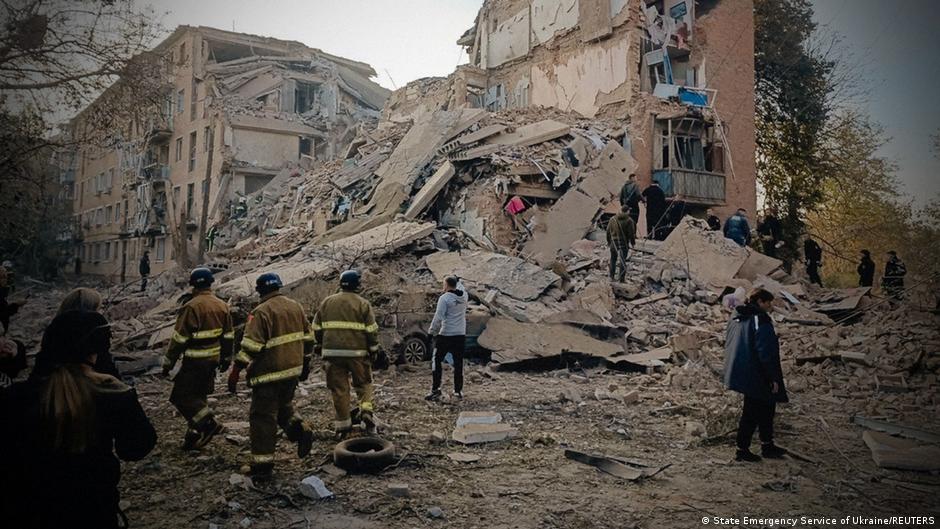
Interior Minister Ivan Vyhovsky said in a Telegram post on Wednesday evening, October 7, that 28 people had died in Ukraine as a result of a massive bombardment by Russian forces. According to him, employees of the State Emergency Service and police officers managed to pull people from rubble, evacuate them from damaged buildings and rescue them from fires. In total, 29 people were extracted, evacuated or saved, he said.
Vyhovsky added that debris removal had been continuing for more than 14 hours in Pryluky, where a missile struck a residential apartment building. The city, in Chernihiv region, became one of the focal points of the attack and of the emergency response that followed.
President Volodymyr Zelensky said later the same evening that 100 people were injured in the attacks. He described the strike as combined, involving many ballistic missiles, many cruise missiles and Shahed drones, followed later in the day by additional drone and aerial bomb attacks.
“The strike was combined: many ballistic missiles, many cruise missiles, Shaheds,” Zelensky said, according to his post.
A security shock for business continuity
For Ukraine’s startup ecosystem, the attack is another reminder that the war remains not only a humanitarian and military crisis but also a constant operational constraint. Technology companies working from Ukraine have spent years adapting to air alerts, power disruptions, staff displacement and interrupted logistics, while still serving domestic and international customers.
The latest barrage, by striking across a wide geographic area, reinforces the challenge for founders attempting to maintain business continuity and for venture investors assessing risk. Zelensky said Russian forces attacked 13 regions of Ukraine on October 7, using 70 missiles, extensive ballistic firepower and Shahed drones.
That scale matters for startups because the Ukrainian technology sector is distributed across multiple cities and regions, not concentrated in one isolated business district. Engineering teams, product operations, support functions and founder networks can be affected even when a company’s headquarters or customer base is elsewhere. The broader the attack footprint, the harder it is for companies to assume that relocation within the country fully eliminates operational exposure.
The human impact in Pryluky was especially severe. According to Vyhovsky, 20 people were killed there, including five children. Three of those children were one year old. Zelensky said debris removal continued throughout the day after the Russian missile strike on the city. Vyacheslav Chaus, head of the Chernihiv regional military administration, had earlier reported more than 50 people injured as a result of the attack.
For international venture capital firms and strategic acquirers, such incidents add pressure to due diligence around resilience planning, employee safety, infrastructure redundancy and geopolitical exposure. Ukrainian companies have often sought to reassure customers and backers by building distributed teams, backup systems and overseas legal or commercial structures. But repeated strikes on civilian infrastructure and residential areas keep war risk at the center of investment conversations.
Sanctions, capital and the innovation ecosystem
Zelensky used his statement to call on leaders not to remain silent about the attack and about what he said was Russia’s intention to continue moving toward escalation, killings and shelling. He said Russian President Vladimir Putin does not feel that this creates problems for him.
The Ukrainian president also linked the military campaign to the international sanctions regime, arguing that any weakening of sanctions against Russia, or signals about lifting sanctions from oligarchs, sends Moscow signals about the normalization of the war against Ukraine. He said Putin can still sell oil and that, when calculating profits in dollars and euros, the war still pays off and remains profitable for him to conduct.
That argument has direct relevance for the venture and technology community because sanctions policy shapes the broader capital environment in which Ukrainian companies operate. The durability of Western pressure on Russia affects expectations about the war’s duration, the willingness of foreign investors to underwrite Ukrainian exposure and the strategic outlook for cross-border mergers and acquisitions involving Ukrainian teams or assets.
Zelensky called the situation a problem not only for Ukraine and its people, but for everyone in Europe and the Western world. For the innovation economy, that framing reflects a wider concern: the war is not confined to the battlefield but influences energy markets, cybersecurity risk, defense technology demand, supply chains and the investment climate across Europe.
Ukraine’s technology sector has continued to produce software, defense-tech initiatives and globally oriented startups during the war. Yet each major bombardment highlights the fragility behind that resilience. Founders must account for staff welfare and emergency response as much as product milestones. Investors must weigh growth potential against the practical realities of operating under missile and drone attack. Acquirers must evaluate whether teams can continue delivering under crisis conditions.
The October 7 strikes therefore carry consequences beyond the immediate destruction. They sharpen the risk calculus for venture funding, complicate M&A timelines and reinforce the importance of infrastructure resilience across Ukraine’s startup landscape. Above all, the reported deaths and injuries show that the innovation ecosystem is operating amid a war whose costs remain immediate, civilian and severe.