German Military Opt-Outs Surge as Startups Face Talent Market Uncertainty
More than 12,000 people in Germany declared unwillingness to serve in the armed forces in the first eight months of 2026.
Germany’s debate over military service is becoming a labor-market issue for the country’s innovation economy, as young people respond in growing numbers to a revamped Bundeswehr recruitment system. From January through the end of August 2026, at least 12,102 people declared that they were unwilling to serve in Germany’s armed forces, according to figures received by the Federal Office for Family and Civil Society Affairs, BAFzA, and reported by the Funke media group on Monday, October 5.
The figure is sharply higher than last year’s total. In all of 2025, German authorities received 3,879 applications from people seeking recognition as conscientious objectors. Funke noted that the number recorded in just eight months of 2026 was therefore more than three times the full-year 2025 total.
For founders, venture investors and technology employers, the data adds another layer of uncertainty to Germany’s already tight competition for young technical talent. The new system does not amount to an immediate reinstatement of universal compulsory service, but it introduces a formal channel through which 18-year-old men are asked about their willingness to join the armed forces. That interaction is now producing both new military recruitment leads and a surge in advance refusals.
Recruitment Reform Meets the Talent Economy
The jump in opt-out declarations follows a reform of Bundeswehr recruitment law that entered into force on January 1. Under the rules, beginning in 2026, 18-year-old men are required to fill out a questionnaire asking whether they are willing to join Germany’s armed forces. Young people may also declare in advance that they refuse military service.
The rise in applications has been attributed to both the tense security environment and the new questionnaire process. For startups, the policy matters because it touches the same age cohort that feeds university programs, apprenticeships, software training pipelines and early-career hiring. Any future partial return of compulsory service could influence when young workers enter the labor market, how companies plan internships and junior hiring, and how venture-backed firms compete with the public sector for motivated recruits.
BAFzA has also warned that many filings are procedurally flawed. A representative of the office said objectors often make mistakes when completing their applications, and that the contents frequently do not meet the requirements for recognizing an objection as justified. As a result, such applications have to be returned without review, the official was quoted as saying.
Applications often do not meet the requirements for recognizing an objection as justified and therefore have to be returned without review, according to BAFzA.
That administrative friction may matter for the private sector as well. If the rules remain difficult to navigate, employers, universities and civic groups may face pressure to help young people understand how military-service obligations or opt-out procedures affect education and career planning.
Bundeswehr Expands Its Recruiting Funnel
Germany suspended compulsory military service in 2011, but the Bundestag could partially reintroduce it under what is described as a military obligation based on need. The mechanism is expected to be used if the Bundeswehr fails to reach the required number of volunteers. The German Defense Ministry’s plans call for as many as 260,000 people to be serving in the Bundeswehr at the same time by 2035.
The armed forces have been widening their recruitment channels in recent years, including by appearing at Gamescom in Cologne, one of the world’s largest video game trade fairs. That presence puts the Bundeswehr directly in front of an audience that also overlaps with Germany’s gaming, software, esports, simulation and digital media sectors. For venture-backed companies in those fields, military recruitment is no longer a distant public-sector process; it is increasingly active in the same cultural and technical spaces where startups seek young users, creators and employees.
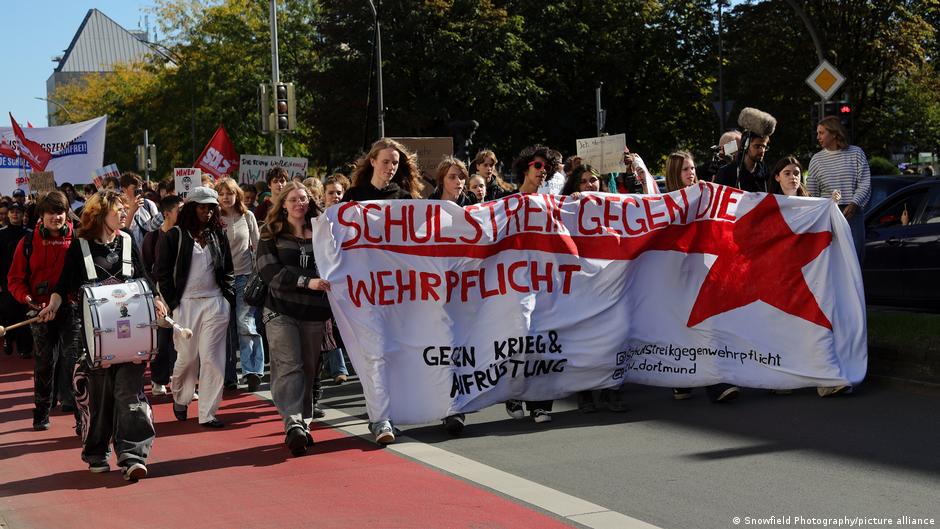
The idea of a possible return of need-based military obligation has drawn criticism from German students. In September, large protests connected to the issue took place in several cities across the country.
At the same time, the Bundeswehr’s own recruitment numbers have improved. In late July 2026, the German Defense Ministry reported that the armed forces had reached their highest personnel level in 13 years, with 186,700 service members. Compared with July 2025, that represented growth of more than 2%, or 3,700 service members.
The ministry said that of roughly 378,000 people who had been sent questionnaires since the start of 2026, around 2,630 completed the service suitability assessment process in July alone. That was 35% more than in the previous month.
By that point, about 12,100 volunteers and short-term contract service members were already serving in the Bundeswehr under the new recruitment system. That was approximately 6% more than a year earlier.
Potential Implications for Startups and Investors
The Defense Ministry also recorded a significant increase in applications and admissions for contract military service. In July 2026, 47,300 people submitted such applications, up 26% from the same month of the previous year. As of the end of July, the number of new recruits stood at 15,400, a 12% increase compared with 2025.
For Germany’s startup ecosystem, the numbers point in two directions at once. On one hand, the growth in military applications suggests the Bundeswehr is becoming a more effective competitor for young talent, especially as it modernizes recruitment and reaches audiences through channels such as gaming events. On the other hand, the surge in conscientious objection declarations shows that a large share of young people are actively resisting the prospect of service, a signal that could shape public debate, political risk and workforce planning.
Venture capital firms evaluating German startups may not immediately model military-service reform as a central risk. But in sectors dependent on early-career technical labor, including cybersecurity, gaming, defense tech, AI infrastructure and industrial software, the policy environment could become more relevant. A partial return of compulsory service, even if triggered only by insufficient volunteer numbers, would affect the timing and availability of young workers entering the labor force.
The debate also intersects with innovation policy. Germany and other European governments are trying to strengthen defense capabilities while also building more competitive technology ecosystems. If the Bundeswehr’s recruitment drive succeeds, it could increase demand for digital skills inside the military. If it accelerates resistance among students and young professionals, it could deepen tensions between national security priorities and the private innovation economy.
For now, the clearest signal is volatility. Germany’s armed forces are attracting more applicants, but they are also prompting many more people to formally declare that they do not want to serve. Startups, investors and policymakers will be watching whether the questionnaire system stabilizes as a recruitment tool or becomes a flashpoint in the competition for Germany’s next generation of talent.