Germany’s anti-extremism protests put political risk back on startup agenda
Demonstrations across more than 35 German cities highlighted rising concern over the AfD and the stability signals watched by investors.
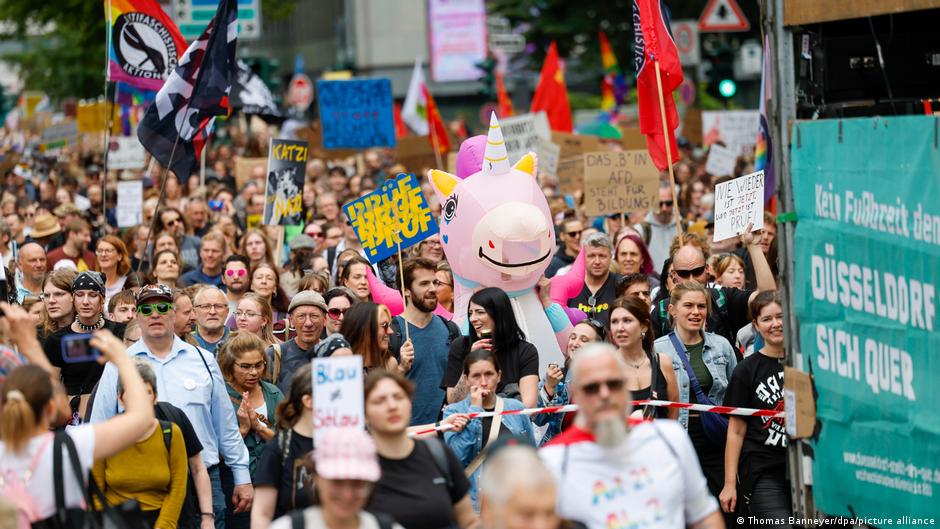
Mass demonstrations against right-wing extremism took place in more than 35 cities across Germany on Saturday, September 12, putting the country’s political climate back in focus for founders, venture investors and technology companies that depend on predictable institutions, open labor markets and cross-border confidence.
Organizers estimated that 25,000 people joined the protest in Hamburg, while around 20,000 took part in Düsseldorf and 18,000 in Berlin, according to police estimates in the capital. The actions came one week after the far-right Alternative for Germany, or AfD, won state elections in Saxony-Anhalt, a result that has sharpened debate over how German institutions should respond to the party’s growing electoral strength.
For Germany’s startup ecosystem, the protests are not only a domestic political story. The country competes for engineering talent, venture capital and acquisition interest in a European market where investors closely watch rule-of-law signals, social cohesion and the durability of mainstream political consensus. Large public demonstrations against extremism can therefore become part of the broader risk map that global funds, strategic buyers and founders use when deciding where to hire, incorporate, expand or allocate capital.
Protests span major startup and industrial hubs
According to the source article, tens of thousands of people joined demonstrations in more than 35 German cities. More than 100 associations were involved in organizing the protests, which took place a week after the AfD’s victory in Saxony-Anhalt.
In Munich, public broadcaster ARD estimated turnout at 12,000. In Hamburg, organizers put the number at 25,000. In Düsseldorf, organizers estimated approximately 20,000 participants, a figure also confirmed by local police. In Berlin, law enforcement estimated that around 18,000 people took part. Around 2,000 people protested in Mainz.
Smaller demonstrations were also held in several state capitals and regional centers. In Magdeburg, the capital of Saxony-Anhalt, around 1,100 people joined the action. In Saarbrücken, about 1,500 people took part. In Erfurt, several hundred people participated. In Schwerin, the capital of Mecklenburg-Western Pomerania, several dozen people joined a protest one week before local elections in a state where polling also showed the AfD in the lead.
The geographic spread matters for business because Germany’s technology economy is not confined to Berlin. Munich is a major center for deep tech, enterprise software and industrial innovation; Hamburg and Düsseldorf are important commercial hubs; and smaller regional cities connect startups to universities, manufacturing networks and public-sector customers. A national wave of protests across these locations underscores how political polarization is being felt beyond federal politics in Berlin.
Calls for closer scrutiny of the AfD
In several cities, including Munich, Mainz, Saarbrücken and Magdeburg, the demonstrations were held as part of the Prüf campaign. The campaign calls for thorough review of the activities of parties classified by Germany’s Federal Office for the Protection of the Constitution, or BfV, as either suspected of right-wing extremism or definitely right-wing extremist.
The campaign name translates from German as “check.” Organizers also present Prüf as an acronym for “Prüfung Rettet Übrigens Freiheit,” meaning “Review, incidentally, saves freedom.”
“Review, incidentally, saves freedom.”
At the demonstrations, participants called for the launch of proceedings to ban the AfD. In May 2025, the BfV classified the AfD as right-wing extremist at the federal level. However, that classification is not currently in effect because of a lawsuit filed by the party.
Local protest slogans reflected the same institutional framing. In Düsseldorf, demonstrators marched under the slogan “Not one step back! Against the AfD and right-wing agitation” (“Kein Schritt zurück! Gegen die AfD und rechte Hetze!”). In Hamburg, the slogan was “Time to act — freedom must be defended” (“Zeit zum Handeln — Freiheit muss verteidigt werden”).
For founders and venture investors, the immediate business implications are indirect but significant. Calls for a party ban, legal challenges to intelligence classifications and debates over democratic safeguards all feed into perceptions of institutional resilience. Venture capital typically prices uncertainty harshly, particularly when uncertainty touches immigration policy, public procurement, academic collaboration, data regulation or the openness of local markets to international teams.
Germany remains one of Europe’s core markets for startup formation and scale-up activity, but the sector relies heavily on confidence that foreign founders, technical workers and investors can operate within a stable and pluralistic environment. Political shifts that raise questions about inclusion or cooperation across party lines can affect founder morale and the way overseas backers discuss country risk, even before any formal policy changes occur.
Polling shows a divided electorate
The protests unfolded against a divided public backdrop. An INSA public opinion poll conducted on September 10 and 11 found that 42% of respondents supported the idea of banning the AfD, while 45% opposed it.
The same poll found that nearly half of Germans, 46%, opposed the “firewall” policy toward the AfD, which means refusing cooperation with the party. Thirty-four percent supported maintaining that barrier, while another 20% were unable to answer.
That split is likely to be watched closely by investors assessing whether Germany’s political center can maintain clear operating norms. The “firewall” debate is particularly relevant to the innovation economy because state and municipal governments can influence digital infrastructure, education, immigration implementation, procurement, regional development funding and support for research ecosystems. If political cooperation rules become less settled, founders may face a more complex environment when engaging with local authorities or planning regional growth.
For M&A and later-stage funding, the signal is similar. Buyers and growth investors often evaluate not only company performance but also the durability of the markets in which companies operate. Political fragmentation can complicate diligence around future regulation, talent retention and public-private partnerships. Conversely, large civic mobilizations against extremism may be read by some investors as evidence that Germany’s civil society remains active and willing to defend democratic norms.
The September 12 demonstrations therefore add another layer to Germany’s startup story. They do not change company fundamentals by themselves, and the source article does not report any direct effect on funding, acquisitions or startup operations. But they do show that the political context around Europe’s largest economy is becoming harder for technology executives and investors to treat as background noise.
For the venture market, the key question is whether Germany can keep presenting itself as a stable, globally attractive base for innovation while its domestic politics grow more polarized. The protests in Hamburg, Düsseldorf, Berlin, Munich and dozens of other cities suggest that many citizens see democratic resilience as an urgent issue. For startups and their backers, that resilience is also part of the infrastructure on which long-term company building depends.