Pussy Riot and Femen Protest at Russian Pavilion in Venice Biennale Amid Political Tensions
Activists demand representation of pro-Ukraine political prisoners, highlighting intersection of art and political dissent at the Venice Biennale.
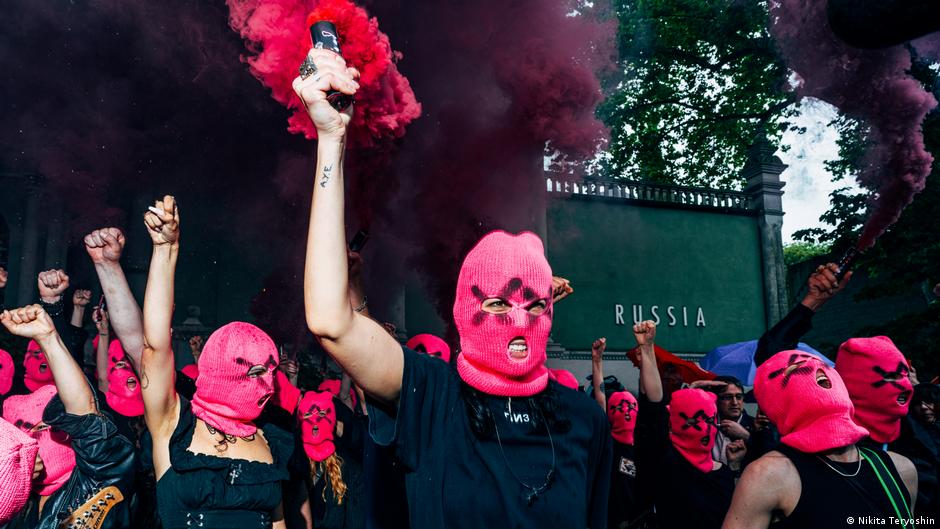
On May 6, members of the feminist punk rock group Pussy Riot and the Ukrainian women's movement Femen staged a joint protest in front of the Russian pavilion at the Venice Biennale. The action was aimed at demanding that Russia be represented by political prisoners holding pro-Ukrainian views at the prestigious contemporary art exhibition.
The activists ignited pink, yellow, and blue smoke flares—the colors of the Ukrainian flag—and chanted slogans such as "Russian art is blood." They held placards reading "Enjoy the show - ignore the war," "Curated by Putin, corpses included," and "Art on display, graves below." Some protesters inscribed these phrases on their bodies. Additionally, statues around the pavilion were adorned with Ukrainian flags and masks.
Political Protest at a Prestigious Art Venue
According to Pussy Riot member Nadezhda Tolokonnikova, "The best citizens of Russia are either imprisoned for anti-regime and pro-Ukrainian actions or killed in detention, while Europe opens its doors to Putin's officials and propagandists." She insisted that the Russian pavilion should instead be represented by artists imprisoned for their anti-war and pro-Ukrainian stances.
"Each Russian artwork shown this year stands on an invisible pedestal of Ukrainian blood. You won’t find this in the catalog, but it is the only material truly holding up this pavilion," said Femen leader Inna Shevchenko.
This year marks Russia's first participation in the Venice Biennale since the full-scale invasion of Ukraine. The organizers' decision to include the Russian pavilion has faced sharp criticism from the European Union and Ukraine, with the European Commission stating it violates EU sanctions legislation.
Responding to the controversy, the organizers limited the Russian pavilion's opening to invited guests only from May 6 to May 8, featuring a continuous sound performance titled "Tree Rooted in the Sky." The pavilion will be closed to the public from May 9 onward. Amid criticism of both the Russian and Israeli pavilions, the Biennale jury excluded these countries from award considerations and subsequently resigned.
The Russian pavilion is managed by Smart Art, a company founded by Ekaterina Vinokurova and Anastasia Karneeva. Karneeva is the daughter of a retired general and former deputy director of the state defense conglomerate Rostec. Vinokurova is the daughter of Russian Foreign Minister Sergey Lavrov.
Implications for Tech Startups and the Innovation Ecosystem
The protest and controversy surrounding the Russian pavilion at the Venice Biennale highlight the complex interplay between political dissent, cultural expression, and international perceptions of Russia. For the global technology and startup ecosystem, such geopolitical tensions can have ripple effects, influencing venture capital flows, cross-border collaborations, and innovation partnerships.
Russian tech startups, already navigating a challenging environment due to sanctions and restricted access to international markets, face additional hurdles as political conflicts shape global sentiment. The affiliations of those managing prominent cultural platforms like the Russian pavilion with government and defense entities may further complicate perceptions of Russian innovation entities.
Moreover, the artistic protest underscores the role of cultural and social movements in drawing attention to political realities, a dynamic increasingly relevant for startups working at the intersection of technology, social impact, and civic engagement. The global venture capital community continues to monitor how these tensions influence the broader ecosystem, affecting investment decisions and strategic priorities.