Russian Missile Strikes on Kyiv Cause Civilian Casualties and Damage to UNESCO Heritage Site
Russian attacks on Kyiv and Kharkiv result in nine deaths, major fire at Kyiv-Pechersk Lavra, and widespread infrastructure damage.
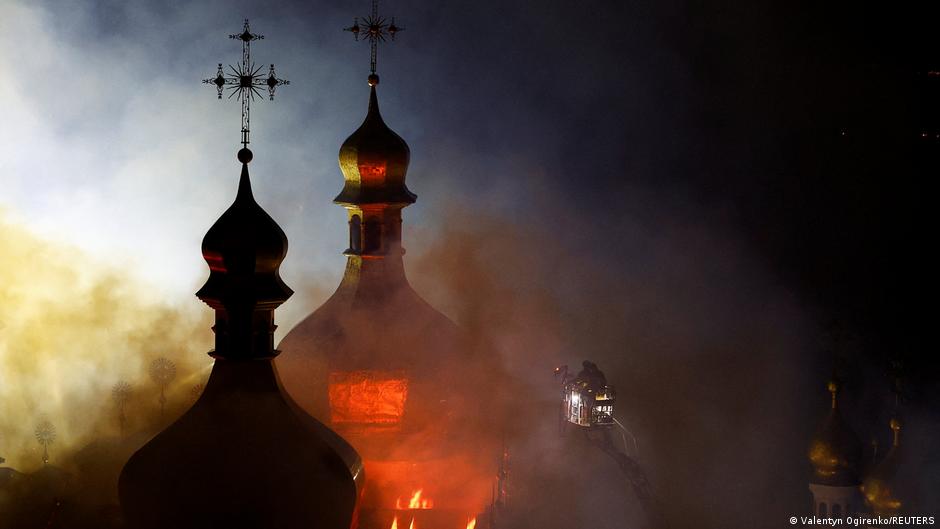
On the night of June 15, Russian forces launched a series of missile strikes against Kyiv, Ukraine's capital, causing significant destruction and loss of life. The attacks included a direct hit on the Kyiv-Pechersk Lavra, a UNESCO World Heritage site, sparking a large fire in the historic monastery complex.
Kyiv's Mayor, Vitali Klitschko, confirmed that the roof of the main cathedral, the Assumption Cathedral, caught fire following the strikes. The head of Kyiv's military administration, Timur Tkachenko, reported that the fire was extensive. Witnesses shared videos on social media showing the blaze engulfing parts of the monastery grounds.
Impact on Civilians and Infrastructure
In addition to the cultural site damage, the missile strikes caused destruction across multiple residential districts of Kyiv. In the Pechersky district, a five-story residential building was hit, while a nine-story building in the Solomensky district also sustained damage. In the Obolonsky district, a residential building partially collapsed after being struck. The Shevchenkivsky district experienced impacts on civilian infrastructure, including a market and a grocery store. A 25-story residential tower was also reported to have been hit.
"At least four people were killed and 25 injured in Kyiv alone, with 140,000 residents left without electricity due to damaged power lines," said Kyiv's mayor Vitali Klitschko.
According to Tkachenko, four civilians died in Kyiv, with an additional five fatalities reported in the city of Kharkiv, Ukraine’s second-largest city, where explosions were also recorded. The Ministry of Internal Affairs of Ukraine reported that during firefighting efforts responding to the attacks, five rescuers were killed in a subsequent strike, with at least five others wounded.
The nighttime missile attacks severely disrupted power services in northern Kyiv, leaving approximately 140,000 subscribers without electricity. The scale of damage to civilian infrastructure highlights the increasing humanitarian toll on Ukraine’s urban centers.
Historical and Cultural Ramifications
The Kyiv-Pechersk Lavra, recognized as a national reserve and a UNESCO World Heritage site, has suffered repeated damage since the full-scale Russian invasion began. Previous attacks in January 2023 damaged vital parts of the complex, including the gallery leading to the Far Caves, a highly sacred area for Ukrainian heritage.
UNESCO has officially expressed concern over the vulnerability of Ukraine’s cultural heritage sites during the ongoing conflict, noting that over 1,600 cultural heritage objects have been damaged or destroyed since the start of the Russian invasion. The strikes on the Kyiv-Pechersk Lavra underscore the risks posed to historical landmarks amid warfare.
Venture and Innovation Ecosystem Implications
Beyond immediate humanitarian and cultural losses, the ongoing conflict and infrastructure disruption pose significant challenges for Ukraine's nascent technology and innovation sectors. Kyiv, as the nation’s primary tech hub, relies heavily on stable infrastructure and security to attract venture capital and sustain startup growth.
Repeated missile attacks compromise critical urban infrastructure and threaten investor confidence in the region. The destruction of residential buildings and essential services impacts the talent pool and workforce stability. Additionally, damage to transportation and utilities delays project timelines and amplifies operational costs for startups and tech companies.
International venture capital firms monitoring the region may reassess risk profiles, potentially slowing funding flows critical for innovation and digital economy development in Ukraine. The resilience of Ukraine’s startup ecosystem will depend on rapid restoration of infrastructure, enhanced security measures, and continued international support to mitigate the conflict’s destabilizing effects.