Uzbekistan’s costly first ID cards raise stakes for startup onboarding
A social media debate over first-time ID fees is broadening into a policy question with implications for digital access and the future customer base of tech services.
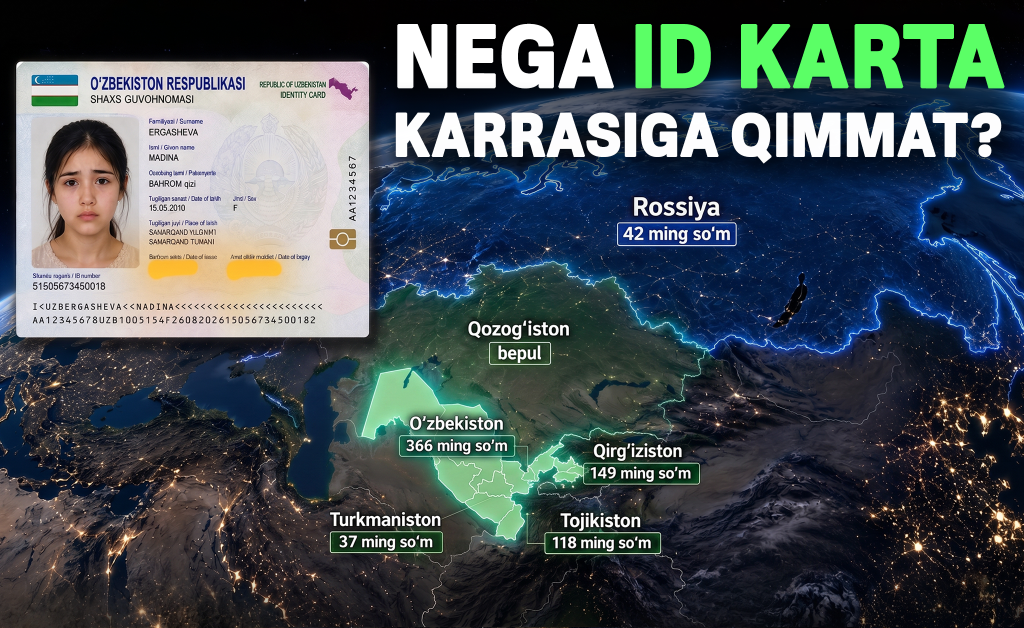
A debate over the cost of obtaining a first ID card in Uzbekistan has moved beyond social media outrage and into a broader question about how much it should cost for a teenager to enter the formal, documented economy. For founders, investors and operators in Central Asia’s tech sector, the issue is not only about a public fee. It also touches a basic input for digital adoption: the first proof of identity that can later support onboarding into financial, government and other regulated online services.
The immediate controversy followed a post by journalist Dilnoza Qurbonova about a girl aged around 15 to 16 who had come with her father to a passport office to receive her first ID card. Qurbonova drew attention to the family’s worn clothing and the visible signs of economic hardship. When the cashier announced the amount due, she wrote, the father’s hands began to shake as he opened his wallet and counted the money one coin at a time, while the girl looked first at her father and then down at the ground.
“He opened his wallet and began counting even the last small coins one by one. Seeing the father’s pain in those seconds, and the daughter’s glance first at her father and then at the ground, made my heart ache,” Qurbonova wrote on Facebook.
The post pushed a more structural question into public view: how fair is the state duty charged for the first identity document in a young citizen’s life, and how does Uzbekistan compare with nearby markets and other countries in the region? The pricing comparison now circulating publicly spans eight countries and systems, including Uzbekistan itself.
Fee structure and why startups care
In Uzbekistan, the state duty for a first ID card depends on how the application is filed. When citizens apply through a migration department, a state services center or a consulate, the fee is set at 89% of the base calculation amount, or BHM. Because the current BHM is 412,000 soums, that works out to 366,680 soums. When the application is submitted online through my.gov.uz, the payment is fixed at 80.1% of the BHM, meaning the current cost of obtaining a first ID card online is 330,012 soums.
Since August 1, 2025, the BHM has been set at 412,000 soums. From September 1, 2026, it will rise to 440,000 soums. If the fee rates themselves do not change, that would lift the first ID-card charge to 391,600 soums for applications submitted through a migration office, state services center or consulate, and to 352,440 soums for applications filed through my.gov.uz.
For Uzbekistan’s innovation economy, that matters for more than household budgets. Identity is the front door to the formal digital economy. A higher entry cost for first-time documentation can become another friction point on the path from offline citizen to verified user, especially for startups that depend on know-your-customer checks, digital signatures or government-linked credentials. In that sense, the public debate is also about the affordability of the first step into digital participation.
Regional benchmarks
The contrast becomes sharper when set against neighboring systems. In Kazakhstan, beginning January 1, 2026, first-time ID issuance became free for every citizen turning 16, and renewal after expiry also became free. The waiver also applies in several other cases, including people receiving the document for the first time after age 18 and people who have acquired Kazakh citizenship. The initiative was designed to reduce the financial burden on citizens and simplify the documentation process.
In Kyrgyzstan, citizens obtaining an ID card for the first time can receive it through the standard procedure within 12 working days for 1,103 Kyrgyz som, equivalent at the current rate cited in the source to about $12.6 or 149,000 Uzbek soums. That makes a standard first ID in Kyrgyzstan about 2.5 times cheaper than Uzbekistan’s current 366,680-soum state duty.
Tajikistan charges $10 to issue a citizen’s ID card, with payment collected in the national currency, the somoni, at the exchange rate on the day of payment. Processing is set at up to 15 days. Using the Central Bank of Uzbekistan’s official rate for August 21, that $10 is roughly 118,000 Uzbek soums, or about 3.1 times cheaper than the amount currently charged in Uzbekistan.
Turkmenistan does not have a separate national ID card; the main identity document is a biometric passport. According to state migration service information cited in the source, the state duty for a biometric passport is 60 manat, equal at the black-market rate to about $3.2 or 37,000 Uzbek soums. Children under 16 are exempt from the payment. On that comparison, the cost is roughly 10 times lower than Uzbekistan’s current first-ID fee.
Russia issues an internal passport once citizens turn 14. The state duty for a first passport is set at 300 rubles, which the source says is about $3.6 or 42,000 Uzbek soums at the current rate, making it roughly 8.7 times cheaper than Uzbekistan’s ID-card charge. Under Russia’s tax code, the same 300-ruble duty applies both to first issuance and to replacement under the standard schedule, while a lost or damaged passport costs 1,500 rubles.
In Turkey, the main identity document is the Türkiye Cumhuriyeti Kimlik Kartı. In 2026, its set price is 220 Turkish lira, equal to about $5 or 59,000 Uzbek soums. But when a child’s birth is registered within the legally defined period and the first identity card is issued on that basis, no fee is charged. A card issued after the deadline or as a replacement costs 220 lira.
In Azerbaijan, identity certificates are issued to citizens from age 15. According to the interior ministry information cited in the source, the state duty for ordinary processing within 10 days is 5 manat.
For Uzbekistan’s startup ecosystem, none of these comparisons automatically determines policy or deal flow. But they do frame the strategic question more clearly. If the first identity credential is priced high relative to regional peers, the burden falls earliest on young users and low-income households. For venture investors and acquirers looking at fintech, regtech or govtech assets, lower onboarding friction can expand the pool of verified users. That is why a fee that begins as an administrative line item can become part of the wider conversation about market infrastructure, startup growth and the innovation ecosystem.