Zelenskyy Warns UN That Putin’s War Strategy Is Spreading Global Risk
Ukraine’s president framed Russia’s war as a widening threat to stability, energy markets, AI governance and the innovation economy.
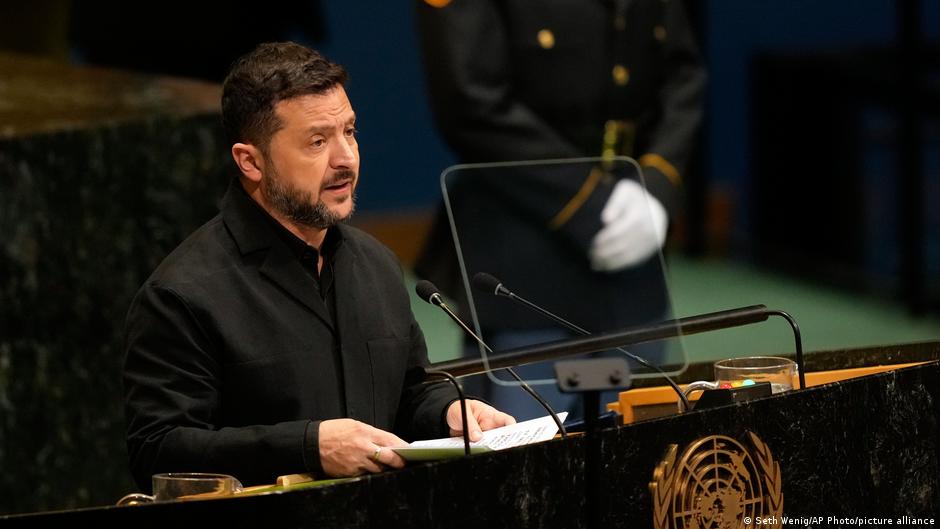
Ukrainian President Volodymyr Zelenskyy used his address to the United Nations General Assembly in New York on Wednesday, September 23, to cast Russian President Vladimir Putin as the origin point of a destabilizing idea that is spreading far beyond Ukraine’s borders. For investors, founders and technology companies, the speech carried a broader warning: the war is not only a military conflict, but a force reshaping energy security, artificial intelligence risk and the global operating environment for startups.
Zelenskyy described Putin as “patient zero” for the idea of war, saying that wherever that idea spreads, it brings pain, instability, new risks and new crises. He argued that Putin must be prevented from acting and denied the ability to spread what he called evil further.
“He must not be allowed to act and must not be given the opportunity to spread this evil further,” Zelenskyy said.
The Ukrainian leader’s remarks came as the war continues to influence markets that matter directly to the venture and startup ecosystem, from energy infrastructure and defense technology to artificial intelligence, cybersecurity and cross-border capital allocation. Venture-backed companies operating in Europe, particularly in energy resilience, industrial software, autonomous systems and security, are increasingly building against a backdrop defined by geopolitical disruption rather than peacetime growth assumptions.
Energy Infrastructure Becomes a Strategic Technology Front
Zelenskyy said that, for the first time in Russia’s history, what he described as the country’s pride, its oil industry, is operating “on its last legs.” He called it difficult to imagine a more humiliating defeat for a country that holds a permanent seat on the UN Security Council and takes pride in its oil exports.
At the same time, he stressed that oil itself is not Ukraine’s target, nor are gasoline, diesel fuel, refineries or ports as standalone objectives. Ukraine’s target, he said, is Russia’s ability to finance and prolong the war. That framing is relevant to the private sector because energy has become both a battlefield and a funding mechanism, with infrastructure, logistics and industrial resilience now central to national security strategy.
Zelenskyy also warned that if Russia continues attacking Ukraine’s energy grid and heating infrastructure, Kyiv will seek to ensure that Russia’s “General Frost” changes sides this winter, a reference to the possibility of retaliatory strikes. The statement underlined how energy systems, long treated by many investors as stable infrastructure, have become dynamic security assets exposed to military and political risk.
For startups, that creates both urgency and uncertainty. Companies working on distributed power systems, grid monitoring, backup energy, drone defense, satellite intelligence and rapid infrastructure repair are operating in a market where demand is growing, but so are ethical, regulatory and procurement challenges. The war has accelerated interest in dual-use technology, yet it has also forced venture investors to rethink where commercial innovation ends and defense capability begins.
AI and the Battlefield Raise New Governance Questions
Zelenskyy issued one of his starkest warnings around artificial intelligence, saying there is a real possibility that as soon as next year, decisions on the battlefield could begin to be made by AI rather than only by humans. He said peace is needed before that point is reached.
That warning speaks directly to one of the most consequential debates in the technology sector: how quickly AI systems should be integrated into military decision-making, and under what controls. The defense technology boom has already drawn venture capital into companies building autonomous systems, battlefield analytics, cyber tools and machine-learning-enabled targeting or surveillance capabilities. Zelenskyy’s comments framed that momentum as a race against time, not only a market opportunity.
For founders and investors, the implications are complex. AI has become a core layer of modern defense and resilience, but the possibility of machines influencing lethal decisions creates reputational, legal and policy risks. Startups in this field may face greater scrutiny from governments, limited partners, customers and civil society groups. The same technology stack that can improve logistics, detect attacks or protect infrastructure can also become part of a rapidly escalating battlefield.
Zelenskyy also cited heavy Russian battlefield losses, saying that from January through August, Russia’s armed forces lost 248,964 people on the battlefield in Ukraine. He said Putin pays 248 people for every kilometer and asked whether anyone still considers him rational. He added that citizens of 47 other countries are fighting on the side of Russia’s army and are also dying on the battlefield.
Those figures were presented by Zelenskyy as evidence of the war’s continuing human cost and its expanding international footprint. For the technology industry, they also underscore how conflict can reshape labor markets, migration, defense spending, sanctions exposure and investor risk models across regions.
The scale of attacks is also increasing, according to the source article’s reference to an AFP analysis. In the first 18 days of September, more Russian strikes were recorded than in any full month since the start of the war in Ukraine, with the exception of March 2022. That escalation raises the stakes for companies working in resilience technologies, humanitarian logistics, communications redundancy and infrastructure protection.
Meanwhile, Russian Foreign Minister Sergey Lavrov told the UN Security Council that there would be no “pause” in hostilities. Taken together, the statements point to a conflict environment that continues to generate strategic uncertainty for Europe’s innovation economy and for global investors exposed to the region.
For VentureLine’s readership, the significance of Zelenskyy’s speech lies not only in its diplomatic message, but in its market signal. The war is accelerating demand for defense innovation, energy resilience and AI governance while increasing the risks attached to each. Venture capital is being pulled toward technologies once considered peripheral to mainstream startup investing. At the same time, founders building in those categories are entering a world where product decisions can carry geopolitical consequences.
Zelenskyy’s central argument was that the spread of war creates instability and crisis. For the startup ecosystem, that instability is already shaping where capital flows, which technologies receive government demand and how investors define risk in the next phase of global innovation.